What Is a Fee-Only Financial Planner in India?
By Abhishek Kumar · Last Updated Date: 20-10-2026
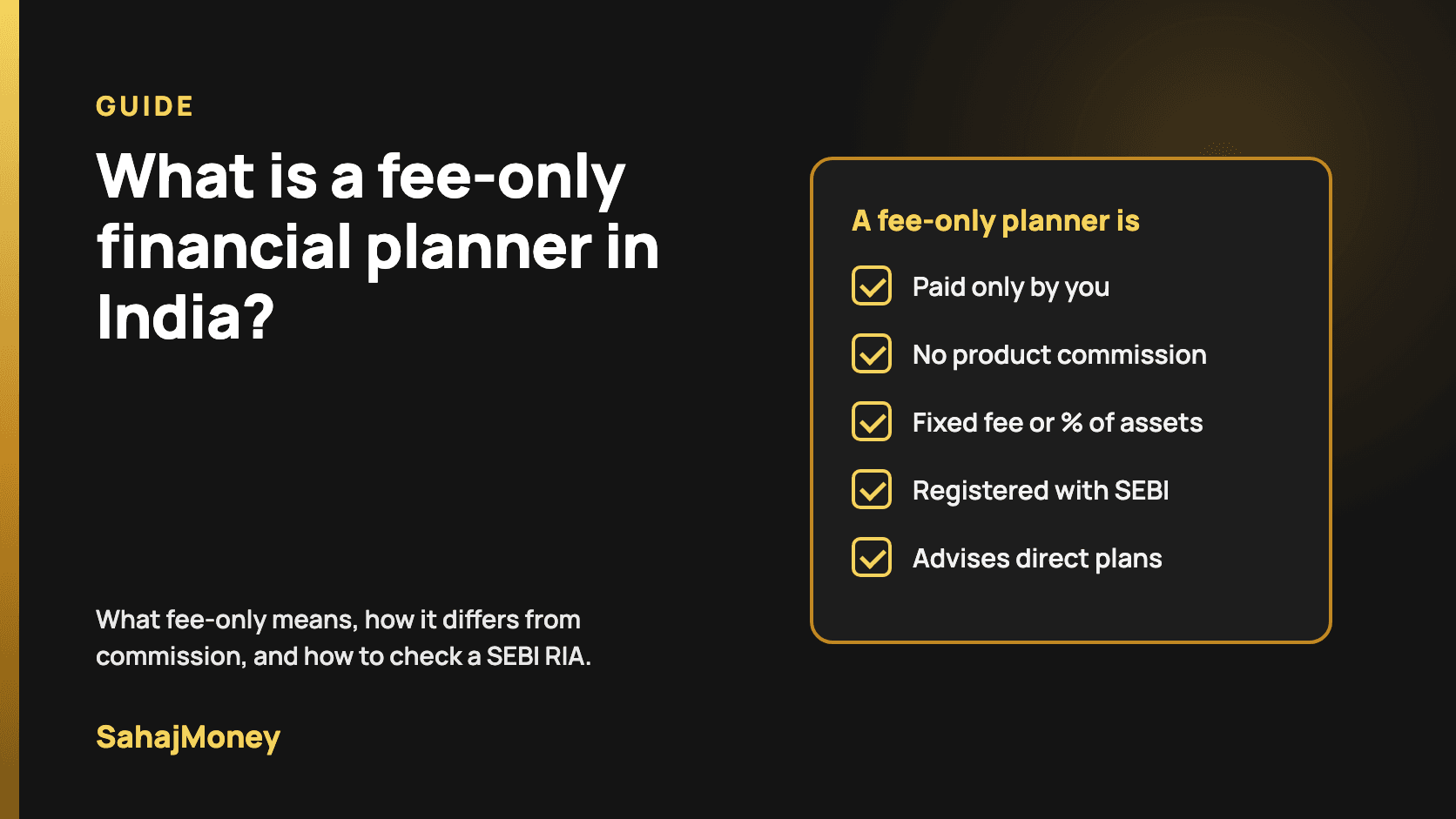
In short: a fee-only financial planner is paid only by you, the client, and earns nothing from the financial products you buy. Indian regulation does not use the term "fee-only". The closest regulated equivalent is a SEBI Registered Investment Adviser (RIA): for its investment advice, an RIA may be paid only by the client, never by product providers.
For individual and HUF clients, SEBI lets an RIA charge for advice on SEBI-regulated investments in one of two ways:
- a fixed fee, of at most ₹1,51,000 a year per family
- a percentage of the assets it advises on, of at most 2.5% a year per family
Here "family" means you plus your dependent spouse, children and parents. Before you pay anyone for advice, check their registration on SEBI's website. This article explains what each term means, how the payment models differ, and how to verify an adviser.
What "fee-only" means
"Fee-only" describes who pays the adviser, not how much they charge. A fee-only financial planner has one source of income for advice: the fee you pay. They receive nothing from mutual fund houses, insurers or any other product provider, whatever you decide to buy.
That single source of pay is the whole point. When the only person paying for advice is the person receiving it, the adviser earns the same amount whether you:
- buy a product or don't
- choose a high-cost fund or a low-cost one
- switch your investments or leave them alone
The recommendation can then rest on what suits you.
The phrase is common in the US, where fee-only planners are a recognised group within the industry. In India, the regulated form of this idea is the SEBI Registered Investment Adviser. Read "fee-only financial planner" in India as "a SEBI RIA who charges you a fee and takes no product commissions". The registration, not the label, is what you can check.
Fee-only vs fixed-fee
The two terms answer different questions:
- Fee-only answers who pays: only you.
- Fixed-fee answers how the fee is set: a flat amount, agreed in advance, that does not depend on how much money you have or invest.
A fixed fee is one way a fee-only adviser can charge. SEBI allows registered advisers two fee modes for individual and HUF clients:
- Fixed fee mode: a set amount, at most ₹1,51,000 a year per family across all the adviser's services on SEBI-regulated investments.
- Assets under Advice (AUA) mode: a percentage of the value of the investments the adviser advises on, at most 2.5% a year per family.
Both are fee-only, since you pay either way and no product provider pays the adviser. The difference is what the fee is tied to. A fixed fee stays the same if your portfolio doubles. An AUA fee doubles with it. With your consent, an adviser may switch you between the two modes at any time, but the total charged can never exceed the higher of the two limits.
Fee-only vs fee-based
"Fee-based" sounds similar but usually means something different. In most markets it describes a professional who charges a fee and also earns commissions on products they sell. Part of the pay comes from you; part comes from the product provider.
In India, SEBI keeps advice and distribution apart for registered advisers. An individual RIA may not offer distribution services at all. An RIA firm must keep the two separate across its group. A client, counting dependent family members as one client, can be an advisory client of the group, paying a fee, or a distribution client, earning the group commission. It cannot be both.
You may still meet professionals who offer a "planning fee" alongside products that pay them commissions. If someone proposes both, ask two questions:
- Which registration does each part of the income come under?
- Which of the products being recommended pay them, or anyone in their group?
SEBI RIA vs mutual fund distributor
Both can talk to you about mutual funds, but they hold different registrations, are paid differently and owe you different things.
| SEBI Registered Investment Adviser (RIA) | Mutual fund distributor (MFD) | |
|---|---|---|
| Registered with | SEBI as an Investment Adviser, and enlisted with BSE Limited, SEBI's supervisory body for advisers | AMFI, holding an ARN (AMFI Registration Number) |
| Paid by | You, through a fee; it may not take payment from anyone else for the investments it advises on | The fund house, through commission included in the scheme's expenses |
| Role | Advice on your finances and investments | Distributing and servicing mutual fund investments, with advice incidental to that |
| Mutual fund plans | Must advise direct plans wherever available | Regular plans, which include the distributor's commission |
| Name | "Investment adviser" | May not call themselves "IFA", "wealth adviser" or similar; AMFI applies this to any "adviser" in a distributor's name |
| Conduct rules | SEBI's Investment Adviser Regulations, including a fiduciary duty to clients | AMFI's Code of Conduct, which requires putting the investor's interest first and checking suitability |
Neither model is wrong in itself. A distributor provides a real service and is paid for it. The difference is who pays and how visible the cost is. A fee shows up as an invoice. A commission is built into what you pay for the product, so many investors never see it as a separate amount.
How fee-only advisers are compensated
For its investment advice, a registered adviser may be paid only by the client, never by anyone else in respect of the products it advises on. For individual and HUF clients, SEBI's Master Circular for Investment Advisers (February 2026) sets these limits:
| Fixed fee mode | AUA mode | |
|---|---|---|
| What you pay | A set amount for the service | A percentage of the value of investments advised on |
| SEBI's upper limit | ₹1,51,000 a year per family | 2.5% of assets under advice a year per family |
| Changes with portfolio size | No | Yes |
Other rules shape how the fee is collected:
- The limits cover advice on SEBI-regulated investments. The cap applies per family across those services and excludes statutory charges such as GST. BSE, SEBI's supervisory body for advisers, revises the fixed-fee limit every three years using the Cost Inflation Index, after consulting SEBI.
- Advance fees are capped at one year. If you agree, an adviser may collect fees in advance, but for no more than one year at a time.
- Early exit is refunded. If you end the engagement early, the adviser refunds the unexpired fees and may keep a breakage fee of at most one quarter's fee.
- No cash. Advisers may not accept fees in cash. Since 1 October 2025 they must also offer a validated UPI ID, with "@valid" followed by the bank's name after the @ (for example, name.ia@validhdfc). Bank transfer and cheque remain available.
- There is a written agreement. The adviser must sign an advisory agreement with you that includes standard Most Important Terms and Conditions (MITC). Among them: the adviser cannot carry out any trade on your behalf without your specific consent for each trade.
- The limits apply to individuals and HUFs. For companies, other non-individual clients and accredited investors, fees are negotiated by contract.
The limits are maximums, not typical prices. Many advisers charge well below them.
What product commissions are
A commission is a payment from a product provider to the person who sold you the product. In mutual funds, it is paid from the scheme's expenses. That is why every fund has two versions:
- Regular plan: includes distributor commission, so its expense ratio (the yearly cost, deducted from the fund's value) is higher.
- Direct plan: bought without a distributor, so it carries no distributor commission and its expense ratio is lower.
Both plans hold the same portfolio. The only difference is cost, and cost compounds.
A worked example. Suppose ₹10 lakh is invested for 20 years and two versions of the same fund differ in cost by 1 percentage point a year. For illustration only, assume the direct plan grows at 10% a year and the regular plan at 9%; actual returns vary and are not predictable.
| After 20 years | |
|---|---|
| Growing at 10% a year | about ₹67.3 lakh |
| Growing at 9% a year | about ₹56.0 lakh |
| Difference | about ₹11.2 lakh |
In the first year the gap is about ₹10,000, which is easy to overlook. Over two decades it grows to about ₹11.2 lakh, more than the ₹10 lakh originally invested, and none of it appears on an invoice.
Two things keep this comparison fair. First, the real gap between a fund's direct and regular plans varies by scheme, and is often smaller for index and debt funds; every fund house publishes both expense ratios. Second, if you use a fee-only adviser, you pay their fee instead. Compare the total yearly cost of each route, not just the commission.
Commissions are not limited to mutual funds. Insurance policies and other financial products can also pay the seller, sometimes at higher rates in the first year. A registered adviser may not take payment from anyone but the client for the securities it advises on, so recommending a cheaper fund costs it nothing.
What AUM-based fees are
An AUM-based ("assets under management") fee is a yearly percentage of the money an adviser looks after. SEBI calls the equivalent for registered advisers the AUA (assets under advice) mode, capped at 2.5% a year per family.
A worked example. On a ₹50 lakh portfolio:
| Fee basis | Yearly fee | If the portfolio grows to ₹1 crore |
|---|---|---|
| 1% of assets under advice | ₹50,000 | ₹1,00,000 |
| 2.5% of assets under advice (SEBI's upper limit) | ₹1,25,000 | ₹2,50,000 |
| A fixed fee of ₹25,000 | ₹25,000 | ₹25,000 |
An AUA fee is still a fee you pay, so it can be fee-only. It has trade-offs:
- For it: the adviser's pay rises when your portfolio grows, which some investors see as shared interest.
- Against it: the fee rises with your wealth even when the work does not. It can also create a quieter conflict: advice that reduces the assets being advised on pays less. Examples are repaying a loan, buying a home, or keeping money in a bank deposit.
A fixed fee avoids that link to your balance. Its own risk runs the other way: an adviser paid the same regardless of effort could do less. Look at what is included and how often your plan is reviewed.
Why conflicts of interest matter
A conflict of interest exists when what is best for you and what pays the adviser best are not the same thing. It does not mean the adviser is dishonest. It means their judgement is under pressure you cannot see.
Every payment model carries some pressure:
| How the adviser is paid | Pressure it can create |
|---|---|
| Commission on products | Recommending products that pay more, more products than you need, or more frequent switching |
| Percentage of assets (AUA) | Keeping money invested with the adviser rather than repaying debt, buying property or holding cash |
| Fixed fee | Doing less work for the same fee |
No model removes judgement from the picture. A good adviser tells you plainly how they are paid and what that pay depends on.
The commission conflict matters most for one reason: it is the hardest to see. A fixed fee or a percentage fee appears on an invoice you approve. A commission is deducted inside a product's costs, year after year, and is easy to miss. As the example above shows, a small yearly difference can become a large sum.
This is why SEBI separates advice from distribution for registered advisers: a registered investment adviser is not paid by the securities it recommends.
How to verify a SEBI RIA
It takes about five minutes, and you should do it before sharing any personal financial details or paying any money.
- Get the registration details. Ask for the adviser's exact registered name and SEBI registration number. An investment adviser's number starts with INA (for example, INA100008045). Registered advisers must show it on their website, advertisements and communications with clients.
- Check SEBI's register. Open SEBI's list of registered Investment Advisers. Search by name or number and confirm the registration is current. The name, address and contact details should match what the adviser gave you.
- Check whom you are paying. Never pay an adviser in cash. Pay only into the adviser's own bank account or validated UPI ID, which has "@valid" followed by the bank's name after the @ (for example, name.ia@validhdfc). Before paying, confirm the UPI ID or bank account with SEBI Check.
- Read the agreement first. A registered adviser must give you a written agreement that sets out the fee, the services and the Most Important Terms and Conditions before you pay.
Warning signs:
- someone calls themselves an "adviser" but cannot give a registration number
- the number belongs to a different name
- someone promises fixed or certain returns
- someone asks for your trading login or offers to trade for you without your consent on each trade
If something goes wrong after you engage a registered adviser, raise it with the adviser first; registered advisers publish their complaint records on their website. If it is not resolved, you can complain on SEBI's SCORES portal.
Questions to ask before hiring one
A good adviser will be glad you asked these. Clear, specific answers are a good sign; vague ones are not.
About pay
- How exactly are you paid, and by whom?
- Which fee mode do you use, fixed or a percentage of assets, and what will I pay in total each year, including GST?
- Do you, or anyone in your group, earn anything from the products you might recommend to me, including insurance?
- What happens to my fee if I end the engagement early?
About the service
- What exactly is included: a written plan, investment recommendations, insurance and tax review, follow-up meetings?
- How often will my plan be reviewed, and what happens between reviews?
- Will you recommend direct plans of mutual funds?
- Can I see a sample plan before I sign up?
About the adviser
- What is your SEBI registration number, and who will actually prepare my advice?
- How will I pay you, and to which account or UPI ID?
- How do you keep my financial information private?
Who may benefit from fee-only planning
Fee-only advice is most useful when your decisions are large, connected, or hard to judge alone. It tends to help:
- People with several goals competing for the same money: retirement, children's education, a home, supporting parents.
- Families who already hold many products: funds, insurance-cum-investment policies, deposits, a mix chosen over the years by different people. They want one independent view of whether it all fits together.
- Do-it-yourself investors who want a second opinion on their portfolio and plan, without being sold anything.
- Anyone facing a major change: a new job, a windfall, a home purchase, early retirement, or managing an elderly parent's finances.
- People who prefer to keep control, investing in their own accounts on the adviser's recommendation, rather than handing over their money.
It may matter less if your finances are simple and you already have adequate term life and health cover, an emergency fund and a low-cost investment habit. Some people want someone to run their money day to day; a portfolio manager does that, which is a different service under a different SEBI registration.
How SahajMoney's model works
SahajMoney is a fixed-fee, fee-only financial planning service in the sense described above. It has been registered with SEBI as an Investment Adviser since 2017 (registration number INA100008045) and is enlisted with BSE, SEBI's supervisory body for advisers. It uses SEBI's fixed fee mode:
| What you pay | What it covers | |
|---|---|---|
| First year | ₹15,000 including GST | A financial plan delivered in about two weeks, with one year of support |
| Each year after | ₹7,500 including GST | Two portfolio reviews a year, with rebalancing recommendations; you place any trades yourself |
The plan covers retirement (including early retirement), your other goals, investments, insurance, tax and your risk profile.
SahajMoney sells no products and earns no commissions, so its fee is the same whatever you invest in. You invest through your own accounts, and your money stays under your control. You can look at a sample plan and check the registration before deciding.
Whichever adviser you choose, use the questions above. A fee-only adviser should be able to answer every one of them clearly.
Disclaimer
This article is general information and education. It is not investment advice for your situation, and the example figures are illustrations, not projections. Rules and fee limits are as published by SEBI at the time of writing and may change.
Registration granted by SEBI, enlistment with IAASB and certification from NISM in no way guarantee performance of the IA or provide any assurance of returns to investors. Investment in securities market are subject to market risks. Read all the related documents carefully before investing.


More of Abhishek's views on choosing an adviser
You may also like
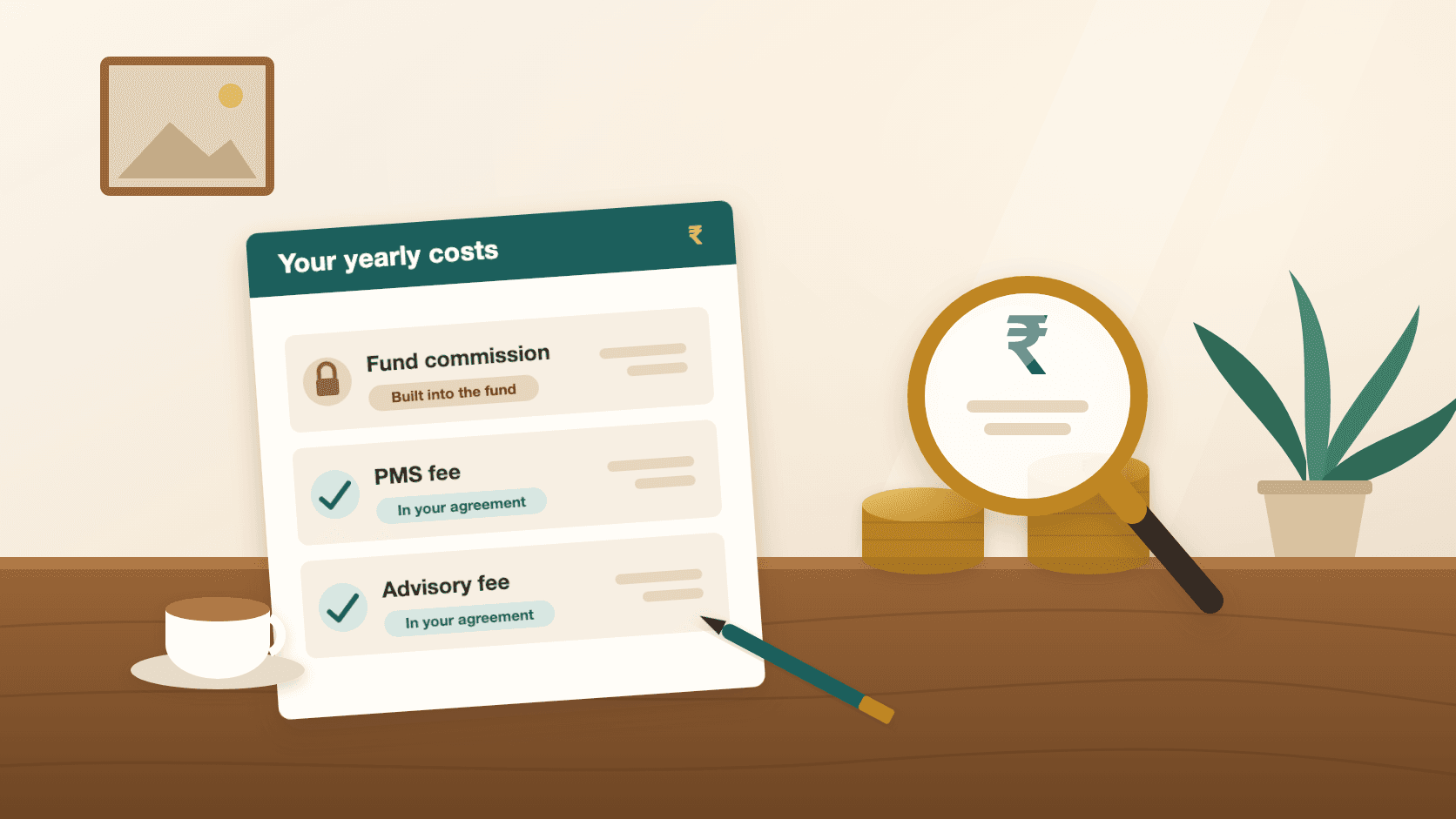
Are Private Banking Fees Negotiable in India?
Private banking and wealth fees in India: which are negotiable, which are set by rules, SEBI's limits, and how they compare with fee-only advice.
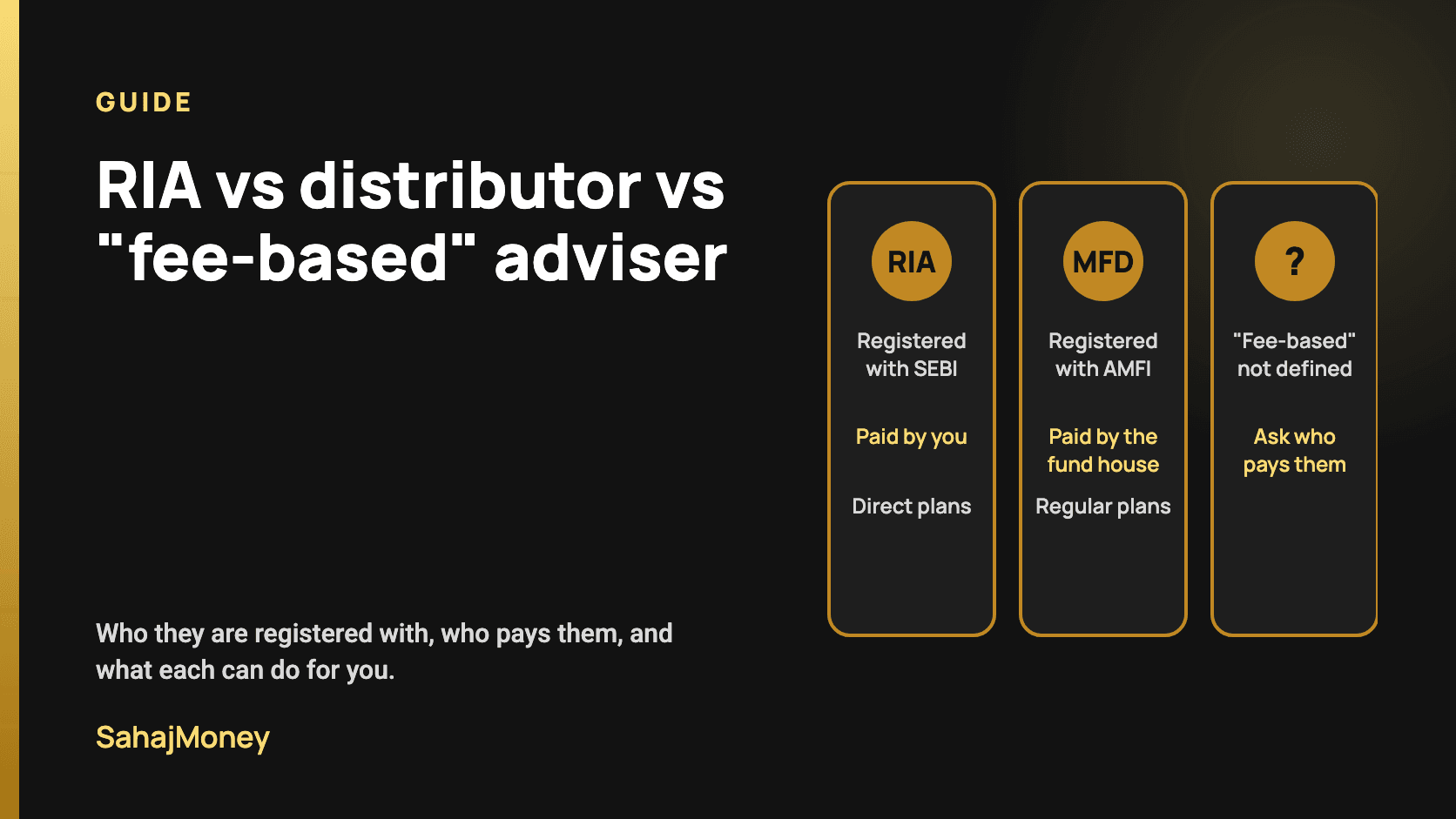
RIA vs Distributor vs Fee-Based Adviser
How SEBI Registered Investment Advisers, mutual fund distributors and "fee-based" advisers differ: registration, who pays them, and what each can do.
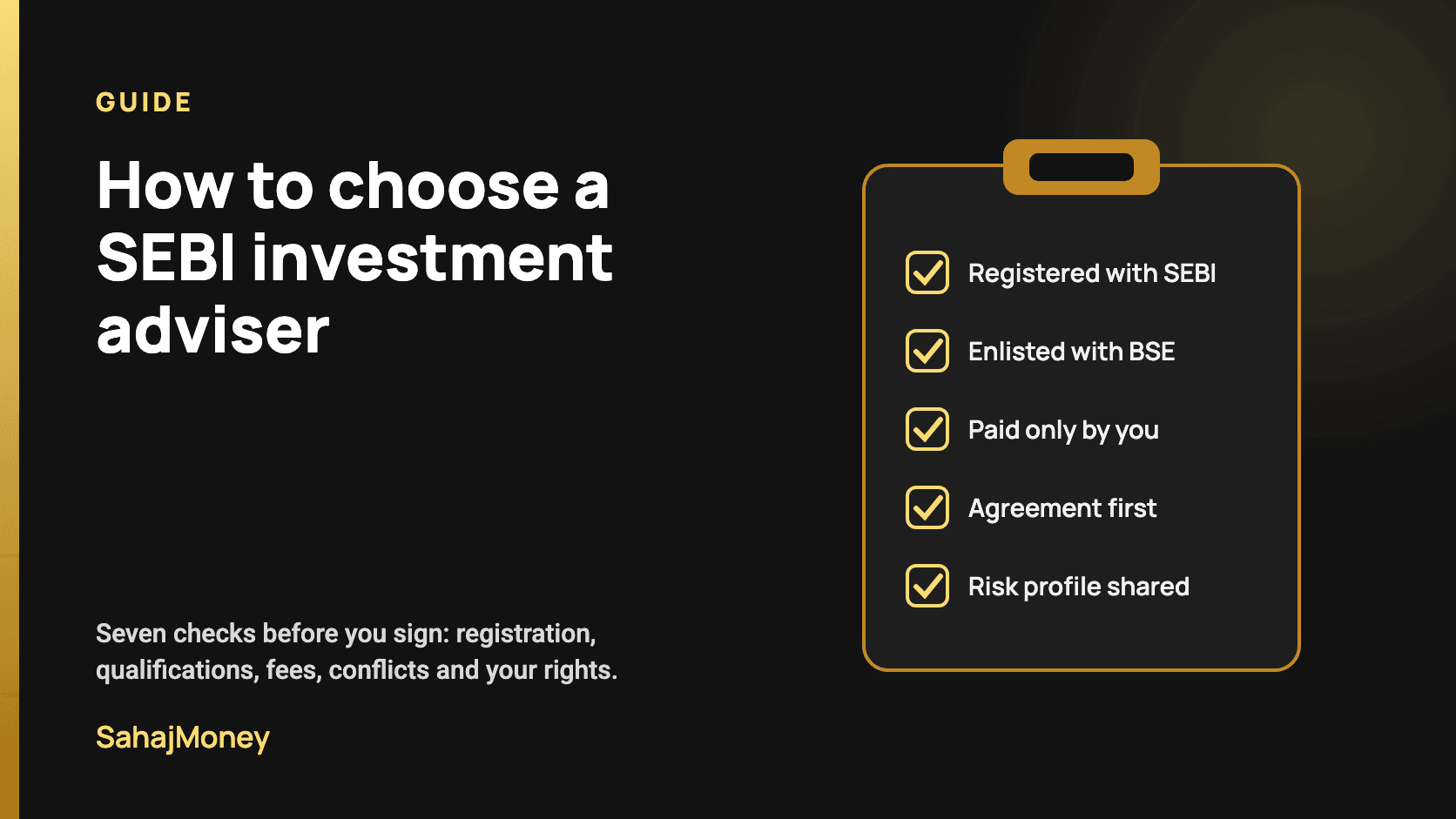
How to Choose a SEBI Investment Adviser
Seven checks before you hire a SEBI Registered Investment Adviser: registration, qualifications, fees, conflicts, the agreement and your rights.
Tailored Financial Advice At a Price You Can Afford!
Speak to SahajMoney® advisor today to achieve your financial goals with confidence.