Are Private Banking Fees Negotiable in India?
By Abhishek Kumar · Last Updated Date: 19-10-2026
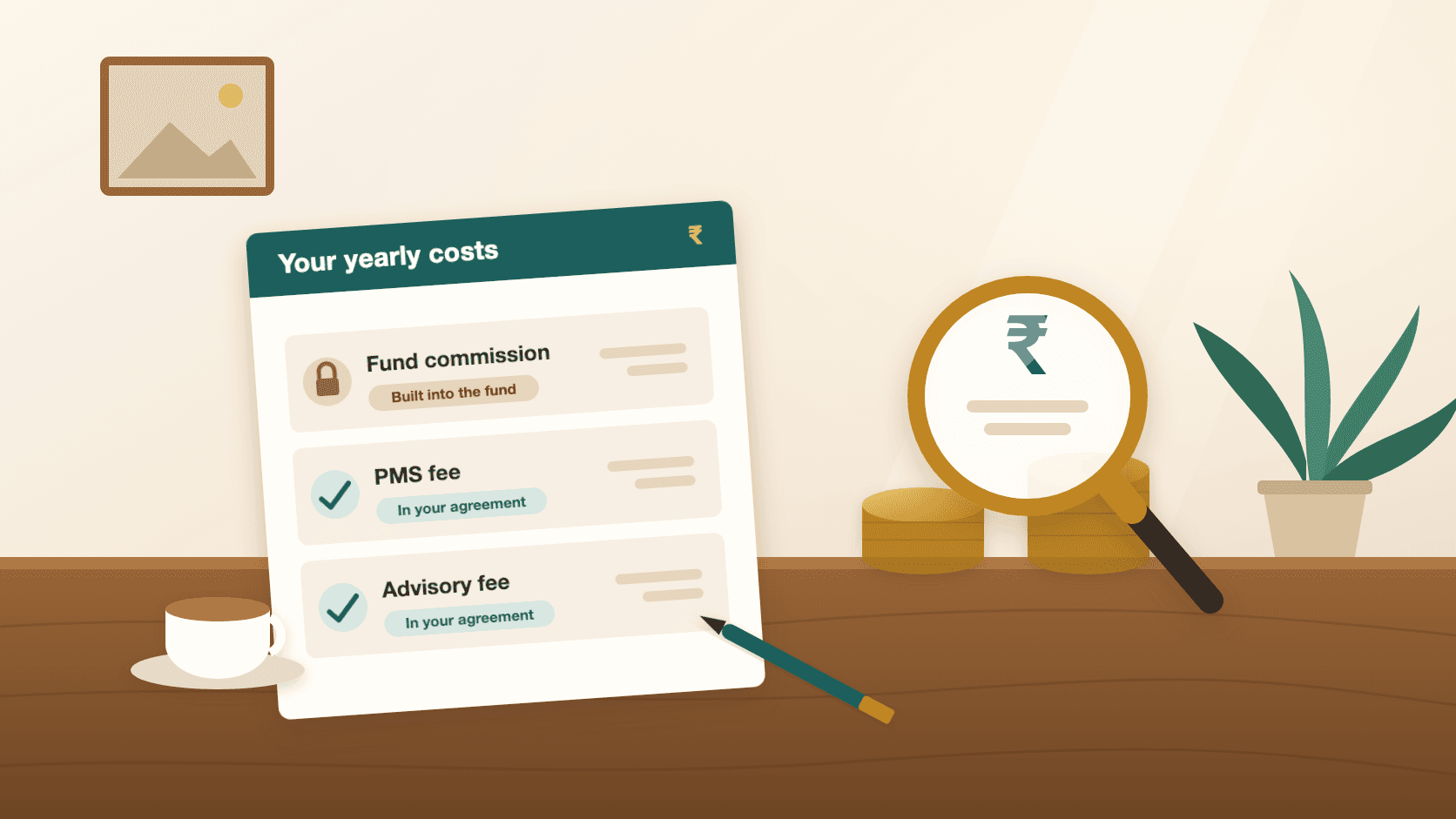
In short: partly. In India, a private banking or wealth management relationship is usually paid in two ways: commission built into the products you buy, and fees you pay directly. The commission inside a mutual fund's regular plan is set by the fund house and, in practice, is not negotiable, but you can avoid it by using the direct plan of the same fund. Portfolio management fees and fees for advice are agreed in writing and can be open to discussion, within limits SEBI sets. For individual clients, a SEBI Registered Investment Adviser may charge at most ₹1,51,000 a year as a fixed fee or 2.5% a year of the assets advised on.
So the useful question is not "can I get a discount?" but "what am I paying for, and which of it is negotiable?" This article takes each part in turn.
How a private banking relationship is paid
"Private banking" and "wealth management" are names for a service, not a registration. Behind the name, each product or service you use comes with its own rules on how its provider is paid:
| What you use | How the provider is paid | Who sets the amount |
|---|---|---|
| Mutual funds, regular plan | Commission paid from the fund's expenses | The fund house (AMC), within SEBI's expense limits |
| Portfolio management services (PMS) | A fee in your agreement: fixed, based on returns, or both | Agreed with the portfolio manager, within the range in its disclosure document |
| Alternative investment funds (AIF) | Management fee, and a placement fee if you invest through a distributor | The fund's documents |
| Investment advice | A fee you pay the adviser | Agreed with you, within SEBI's limits for individuals |
| Insurance | Commission paid by the insurer | The insurer's board-approved policy, within IRDAI's overall expense limits |
Most relationships mix several of these. Your total cost is the sum, and each line has different room for negotiation.
Is mutual fund commission negotiable?
In practice no, but it is avoidable. Since 1 January 2013, SEBI has required every mutual fund scheme to offer a direct plan alongside the regular plan. The direct plan is the same portfolio with a lower expense ratio, because no distribution commission is paid from it. Each plan has its own NAV.
When you invest in a regular plan through a bank or distributor, the commission is paid from the scheme's expenses, as a trail spread over the time you stay invested. SEBI's rules set a full trail model and do not allow upfront commission, apart from a narrow exception for small first-time SIPs. Because the commission is paid from the scheme's expenses, and the expense ratio is the same for everyone in that plan, there is in practice nothing for an individual investor to negotiate.
What you can do:
- Look it up. Your consolidated account statement (CAS) for the half-years ending September and March shows the actual commission, in rupees, paid to distributors on each scheme you hold.
- Compare the two plans. Fund houses publish the expense ratios of the direct and regular plans of every scheme.
- Decide whether the service is worth it. Commission pays the distributor for their service. If you value that service, the commission may be fair to you; if you don't use it, the direct plan costs less.
- Check before you switch. Moving from a regular to a direct plan counts as selling and buying again, so check exit loads and capital-gains tax first.
Are PMS fees negotiable?
Often, within limits. A portfolio manager's fee can be a fixed fee, a fee based on returns, or a combination, and the range of fees must be stated in its disclosure document. The fee that applies to you is set in your agreement, which is where any negotiation happens. Rules that apply to everyone:
- Minimum investment: ₹50 lakh, except for accredited investors.
- No upfront fees. SEBI does not allow them.
- Performance fees are calculated on a high-water mark basis, so a performance fee is charged only on gains above the portfolio's previous highest value.
- Exit load is capped at 3% in the first year, 2% in the second and 1% in the third, and nil after that. For large-value accredited investors, exit load is agreed between the two sides.
- Distributor pay comes only as a trail, only out of the portfolio manager's fee, and you must be told what the distributor earns.
- Direct onboarding. Portfolio managers must let you join directly, without a distributor, with no onboarding charges other than statutory ones.
SEBI has notified new Portfolio Managers Regulations, which take effect on 1 April 2027 and keep the ₹50 lakh minimum, the fee types and the ban on upfront fees.
What about AIF fees?
Alternative investment funds are for larger investors: the minimum is ₹1 crore, with exceptions for accredited investors and a fund's own employees and directors. SEBI requires AIF schemes to offer a direct plan with no distribution or placement fee. If you come through an adviser or portfolio manager who already charges you a fee, you must be placed in the direct plan.
When an AIF is sold through a distributor, the placement fee must be disclosed when you invest. In Category III funds it is paid as an equal trail out of the management fee. Category I and II funds may pay up to one-third of it upfront.
Are advisory fees negotiable?
They can be. A fee for advice is set out in a written agreement that you sign before any advice is given or any fee is charged. SEBI's limits for individuals are ceilings, not set prices, but whether a particular adviser negotiates is up to that adviser. For individual and HUF clients who are not accredited investors, a SEBI Registered Investment Adviser may charge, per family, across all its services:
| Fee mode | SEBI's upper limit (per year) |
|---|---|
| Fixed fee | ₹1,51,000 |
| Percentage of assets advised on | 2.5% |
These limits apply to advice on securities that SEBI regulates, and exclude statutory charges such as GST. Advance fees may cover at most one year, and only if you agree. If you leave early, the unused fee is refunded, less a breakage fee of at most one quarter's fee.
For accredited investors and non-individual clients, such as companies and trusts, these limits do not apply. Fees are set by "bilaterally negotiated contractual terms": in other words, by negotiation.
If you keep your existing distributor-held funds and also pay an adviser for a second opinion on them, you pay both the adviser's fee and the distributor's commission; the adviser must disclose this to you every year.
Two more rules matter in a bank setting:
- Advice or distribution, not both. Within a group, you can be an advisory client or a distribution client, not both. An investment adviser may not take any payment for its advice from anyone other than you, and must advise direct plans wherever they exist.
- Banks advise through a separate entity. Under the Reserve Bank of India's directions, for new business from 1 April 2026, banks may offer investment advisory, portfolio management and broking services only through a group entity, not as a department of the bank.
What to ask before you negotiate
Put the same questions to any private bank, wealth firm or adviser:
- What is my total yearly cost, in rupees, across products and fees, including GST?
- Which of my mutual funds are in regular plans, and what does my CAS show as commission paid?
- Is anyone in your group paid by the product providers for what you recommend, and how much?
- For PMS or AIF: what is the fee structure, is there a performance fee, what is the exit load, and is direct onboarding or a direct plan available?
- Am I an advisory client or a distribution client of your group?
- Am I an accredited investor? If so, which fees are open to negotiation?
- What exactly does the relationship include, and what would I lose if I moved to direct plans?
A worked example, for illustration only: suppose a ₹2 crore portfolio is held entirely in regular plans whose expense ratios are 0.8 percentage points a year higher than the direct plans of the same funds. The difference is ₹1,60,000 a year. The gap varies from fund to fund; these are assumptions, not a projection or a quote, and your CAS and the fund house's published expense ratios give your own figure.
Private banking or fee-only advice?
They solve different problems, and many investors use both.
| Private banking or wealth relationship | Fee-only adviser | |
|---|---|---|
| Registration | Varies: distributor, portfolio manager, investment adviser, often through group entities | SEBI Registered Investment Adviser |
| How it is paid | Product commissions, product fees, sometimes advisory fees | Only by you |
| What you can negotiate | Product fees and advisory fees within their rules; not fund commission | The advisory fee, within SEBI's limits for individuals |
| Who carries out the transactions | Often the relationship team | Usually you, in direct plans |
| Services beyond investing | Often banking and credit under the same roof | Planning and investment advice |
A private banking relationship can bring convenience and services under one roof. A SEBI Registered Investment Adviser is paid only by its client and may not receive any payment from product providers for the products it advises on. Compare the options on total cost and on the service you will actually use.
What SahajMoney charges
SahajMoney is a SEBI Registered Investment Adviser (INA100008045) and charges a fixed fee: ₹15,000 for the first year and ₹7,500 a year to renew, both including GST. The fee is per couple, covers dependent children and parents, and does not depend on the size of your portfolio. SahajMoney earns no commission on any product. Our guide to financial planner fees in India explains how to compare advisory fees in more detail.
Disclaimer
This article is general information and education. It is not investment advice for your situation, and the example figures are illustrations, not projections or quotes. Rules and fee limits are as published by SEBI and the Reserve Bank of India as of October 2026 and may change.
Registration granted by SEBI, enlistment with IAASB and certification from NISM in no way guarantee performance of the IA or provide any assurance of returns to investors.
Investment in securities market are subject to market risks. Read all the related documents carefully before investing.


More of Abhishek's views on money management
You may also like
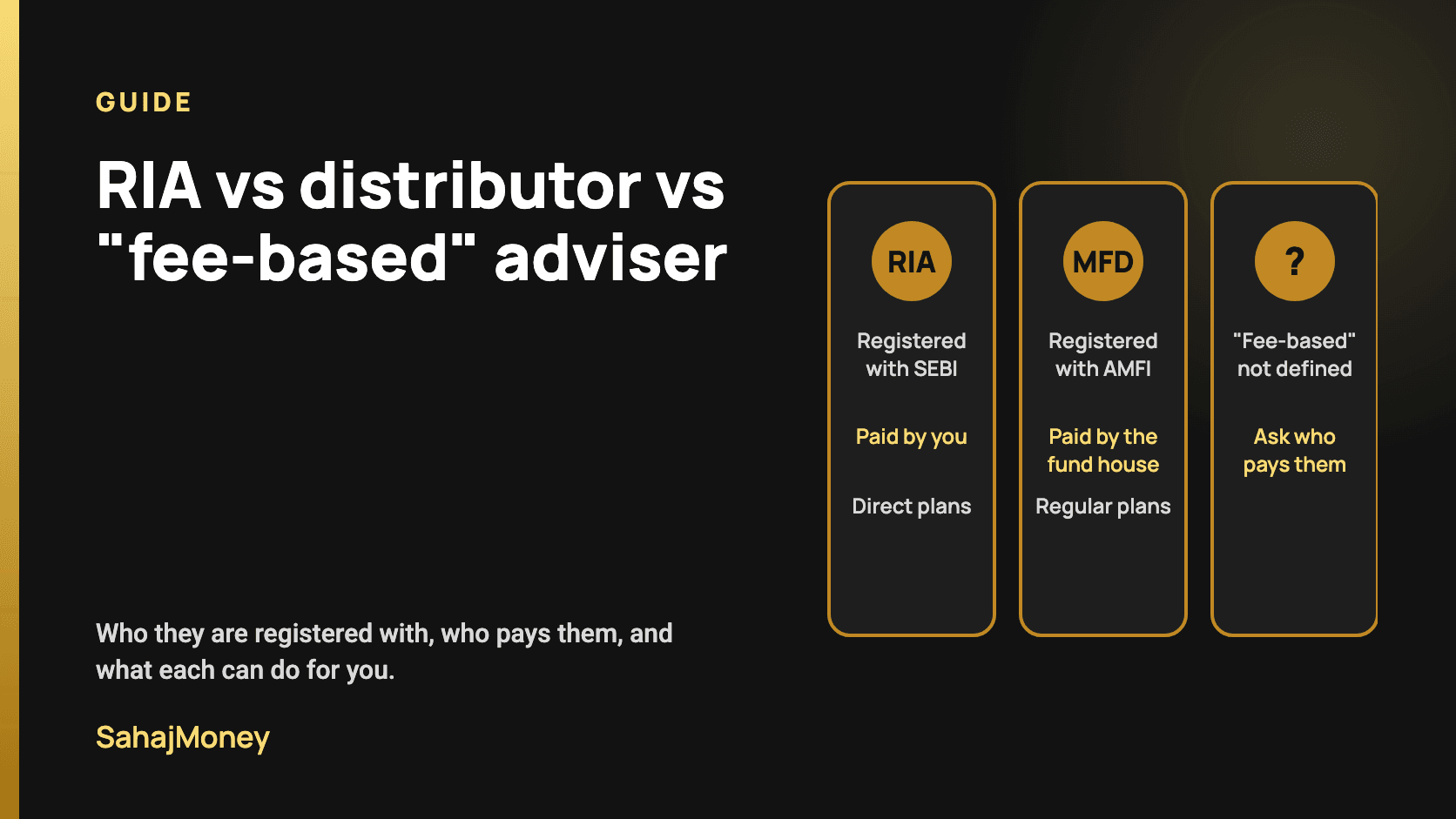
RIA vs Distributor vs Fee-Based Adviser
How SEBI Registered Investment Advisers, mutual fund distributors and "fee-based" advisers differ: registration, who pays them, and what each can do.
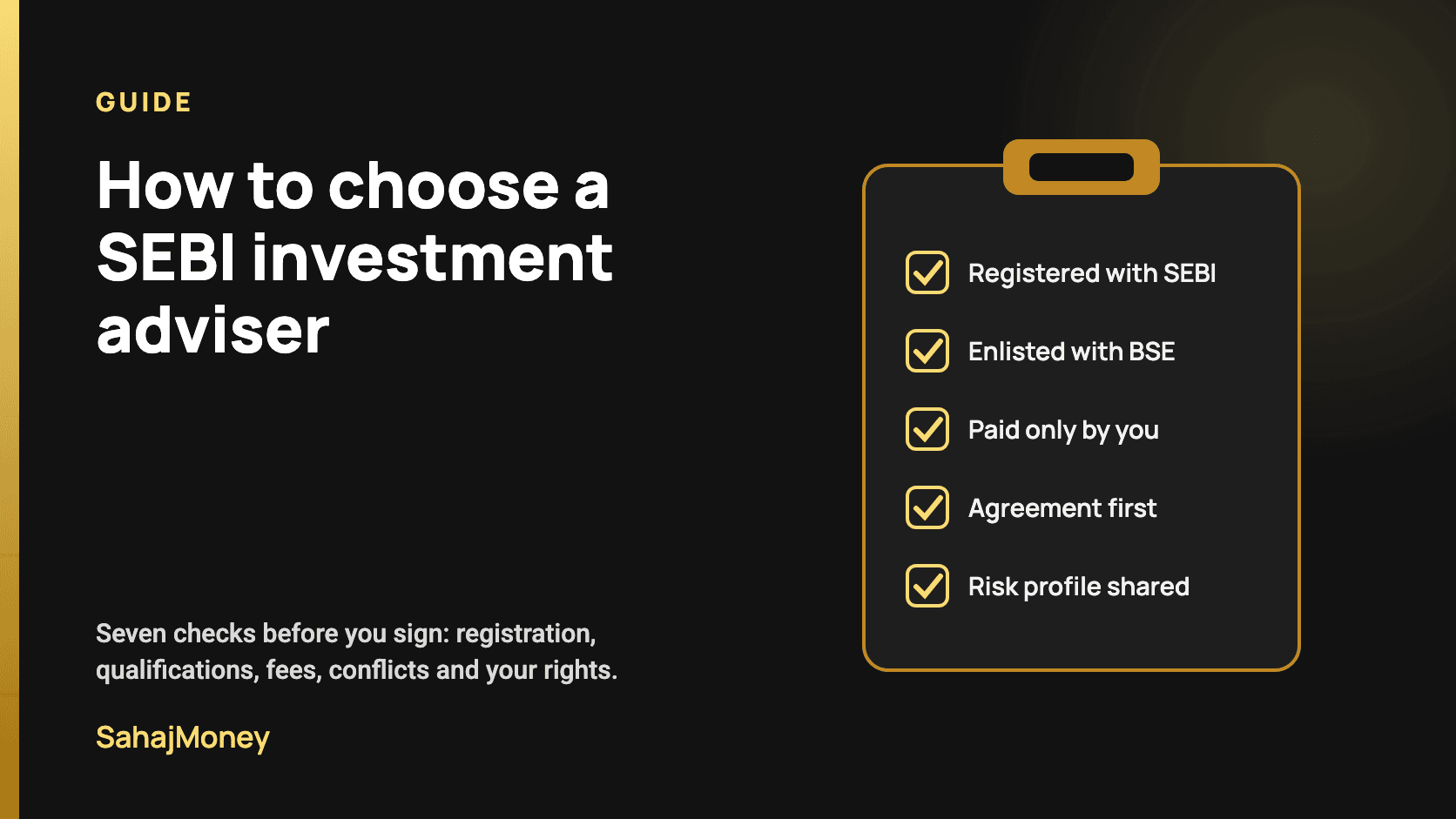
How to Choose a SEBI Investment Adviser
Seven checks before you hire a SEBI Registered Investment Adviser: registration, qualifications, fees, conflicts, the agreement and your rights.

Senior Citizens' Savings Scheme (SCSS) Guide
SCSS explained: who can invest, the ₹30 lakh limit, 8.2% for Oct–Dec 2026, quarterly interest, tax, unlimited 3-year extensions and early exit.
Tailored Financial Advice At a Price You Can Afford!
Speak to SahajMoney® advisor today to achieve your financial goals with confidence.